EQiTherm — Not a one-off project.
Dynamic continuous optimisation.
A combination of hydraulic and thermal balancing — data-driven, AI-supported, continuous, self-learning. Up to 50% savings on heating, up to 30% on drinking water.
Laminare & turbulente Strömung verstehen.
Warum der Volumenstrom in Heizkreisen nicht nur die Wärmemenge bestimmt — sondern den Wärmeübergang selbst. Interaktiv erklärt: die Strömungsphysik, die der Anlagenmanager in jedem Strang optimiert — und die EQiTherm mit dem hydraulischen Abgleich dauerhaft sicherstellt.
Parabolisches Profil — schnell mittig, langsam an der Wand. Wärmeübergang nur per Wärmeleitung (sehr langsam). Druckverlust ∝ v (linear).
Flaches Profil — fast überall gleich schnell. Wärmeübergang durch Quervermischung — 10 bis 100× besser. Druckverlust ∝ v² (quadratisch).
Heating optimisation
Heating system: up to 50% savings.
Without hydraulic balancing
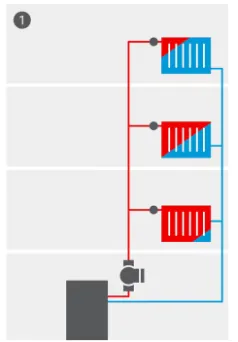
With EQiTherm balancing
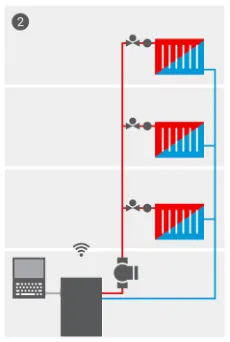
Without hydraulic balancing
- Unreliable heating of rooms
- Unnecessarily high electricity consumption from continuous pump operation
- Flow and whistling noises at the thermostatic valves
- Excessive fuel use from unnecessary heat production
- Corrosion and wear damage from unnecessary hot-water circulation
- Unnecessarily high CO₂ costs
With EQiTherm balancing
- All rooms heat up evenly
- No more flow noises
- Lower electricity consumption through efficient pump operation
- Thermostatic valves work reliably
- Lower wear costs on the heating system
- Significant reduction in fuel quantity (up to 30%)
- Reduction in CO₂ emissions
- Independent ESG certification possible (BREEAM, DGNB, LEED)
Drinking water optimisation
Drinking water system: up to 30% savings.
Problems without balancing
- Uneven temperatures at the draw-off points
- High heat losses due to outlet temperatures of up to 70–75°C (Legionella cycle)
- High costs from unnecessary fuel consumption
- High electricity costs from long pump running times
- Increased pipe wear from high flow velocity (erosion)
Result with EQiTherm
- Even water temperatures at all draw-off points
- Lower heat losses through lower outlet temperature
- Cost savings through lower fuel consumption
- Lower electricity costs through efficient pump operation
- Lower pipe wear through reduced flow velocity
Optimisation process
Conversion measures and settings.
EQiTherm combines structural measures with intelligent configuration — for dynamic, permanent hydraulic balancing under all operating conditions.
Conversion measures
Optimisation of the hydraulic schematic
Review and adjustment of the system circuits and fittings (sizing and mixer control).
Automatic pressure regulation
A prerequisite for dynamic, permanent hydraulic balancing under all operating conditions (part-load behaviour).
Radiator insulation
Reflective foil behind radiators for a more intense perception of warmth — enabling a temperature reduction of 1–2°C.
Radiator replacement
Where necessary, replacement of individual radiators to permanently lower flow temperatures.
Drinking water disinfection
Installation of non-thermal disinfection measures (UV disinfection, ultrafiltration) and automatic backflushing devices.
Settings
Heating curves
Optimal adjustment in line with the calculation results. Switching to return temperature as the controlled variable.
Balancing radiator valves
Synchronisation of the valve settings via AFC valves or electronic thermostat heads.
Output optimisation
Matching the generator output to actual demand. Avoids unnecessary cycling and saves energy.
Pressure balancing
Pressure balancing of the individual distribution circuits and the circulation lines.
Pump settings
Correction of the pump control using the determined target values.
AI-supported capture
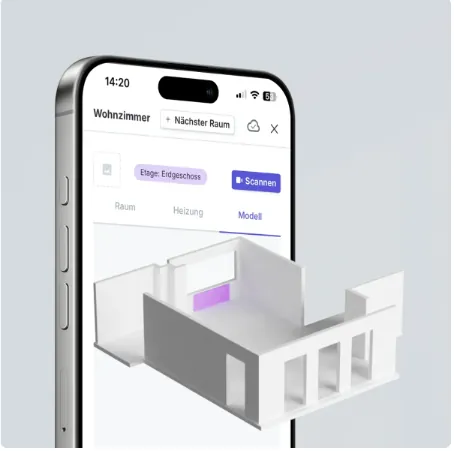
Room and radiator data with AI and LiDAR.
EQiTherm uses LiDAR technology to automatically capture all room and radiator data — faster and more precise than any manual survey.
Room-by-room heat load calculation
Automatic calculation in accordance with DIN EN 12831 — standard-compliant and reproducible.
Automatic radiator identification
AI automatically detects all radiator types. Algorithms suppress irrelevant objects in the room.
Digital documentation & 3D model
A complete 3D model of every room. Floor plan and living-area calculations as a by-product.
Automatic data transfer
Room and radiator data is stored centrally and transferred automatically to the EMS.
Revolutionary hybrid technology
Intelligent thermostatic valves.
EQiTherm relies on a unique hybrid technology: the wax-element actuator regulates the room temperature self-sufficiently — the motor is only needed to adjust the target temperature. The result: extremely long battery life and silent operation.
Long battery life
Thanks to hybrid technology — the wax-element actuator regulates self-sufficiently, with no auxiliary power for room temperature control.
No noise emissions
Silent temperature control — the motor is only active when the setpoint changes.
Intelligent data capture
Compensation for the installation situation and the influence of the heating-medium temperature — self-learning and adaptive.
AFC-compatible
Compatible with AFC bases — though use of AFC is not mandatory.
EMS integration
Automatic data transfer to the energy management system — seamless ACQEOS connection.
Gateway for intelligent building technology
The EQiTherm gateway enables building-wide control and monitoring of all thermostats — centrally, encrypted and remotely.
Adaptive thermal balancing
Beyond hydraulic balancing: thermal balancing.
Thermal balancing complements hydraulic balancing with room-specific, self-learning temperature optimisation — based on measured heat-up rates.
Underlying principle
Even warming of all rooms — the temperature rise per time interval should be the same in every room.
Controlled variable
The trend of the measured actual room temperature yields an individual heat-up rate for each room.
Learning phase
Heat-up rates are determined for each room and compared with one another.
Identification
Rooms with a high heat-up rate (potential over-supply) and a low heat-up rate (potential under-supply) are detected.
Self-learning process
Demand-oriented adjustment via digital thermostats — continuous, not one-off.
Hydraulic + thermal = EQiTherm
Only the combination of hydraulic and thermal balancing achieves maximum efficiency. EQiTherm is not a one-off project — it is a continuous, AI-supported optimisation process.
50%
Heating savings
30%
Drinking water savings
User convenience
Radiators controllable remotely via app.
Tenants and users can conveniently control their radiators via a smartphone app — set the room temperature, create heating schedules, view consumption.
Set the room temperature
Each radiator can be controlled individually via the app — on the move or at home.
Consumption at a glance
Transparent presentation of heating energy consumption per room — motivation to save energy.
HKVO-compliant
Hydraulic balancing by procedure B — certified and standard-compliant. Fundable under BAFA.
System integration
A prerequisite for economical heat pump operation.
Heat pumps work the more efficiently the lower the return temperature is. EQiTherm systematically lowers the return temperature — and is therefore the fundamental prerequisite for the economical operation of E-Switch.
Without EQiTherm
55–65°C
Flow temperature
COP ≈ 2,5
With EQiTherm
35–45°C
Flow temperature
COP ≈ 4,5
Result: By lowering the flow temperature by 20°C, the heat pump's COP rises by 80% — that is the difference between profitable and uneconomical heat pump operation.
Ready for dynamic continuous balancing?
In 30 minutes we will show you how EQiTherm optimises your heating system — with concrete savings figures for your portfolio.
Get in touch
Ready to activate your portfolio?
In 30 minutes we'll show you what economic potential lies within your portfolio.